
Choosing a university is not an easy task for potential students, as there are lots of competitive institutions that are making great strides towards becoming the best. This situation often tends to create confusion amongst students, especially regarding the course of their choice, which is why we recommend the University of Port Harcourt (UNIPORT) as one of the best to give you more than what you seek.
UNIPORT is one of the most popular universities in Nigeria and the world at large. It is also widely renowned for being one of the best entrepreneurial institutions in Africa. Thanks to its several great feats and achievements, it is ranked highly on the list of Nigeria’s and Africa’s best universities. This school covers a lot of program for many students to choose from, and its tuition comes at a very affordable rate. This article will be talking about University of Port Harcourt (UNIPORT) courses, admission requirements, & school fees.
Also Read: Rivers State University (RSU) Courses, Admission Requirements, & School Fees
University of Port Harcourt (UNIPORT): What You Need to Know
The University of Port Harcourt (UNIPORT) is a federal university located in Choba, Port Harcourt, Rivers State, Nigeria. It is one of the foremost universities in the country, and it has grown from its establishment in the 1970s to a large institution with many faculties and departments offering undergraduate, postgraduate, part-time, diploma, and certificate programmes. The university is known for its academic standing, research focus, and diverse course offerings.
University of Port Harcourt (UNIPORT): Courses & Programmes
University of Port Harcourt (UNIPORT) is structured into multiple faculties and colleges, each housing departments that offer specific courses. Some of the main faculties include Agriculture, Basic Medical Sciences, Clinical Sciences, Dentistry, Management Sciences, Engineering, Science, Computing, Education, Humanities, Social Sciences, Pharmaceutical Sciences, Law, and a College of Continuing Education. There are also specialized institutes and schools such as the School of Science Laboratory Technology and the School of Public Health.
Undergraduate Courses
Undergraduate programmes at UNIPORT cover a broad range of disciplines. These are typically Bachelor’s degree programmes leading to degrees such as Bachelor of Science (B.Sc), Bachelor of Arts (B.A), Bachelor of Engineering (B.Eng), Bachelor of Law (LL.B), Bachelor of Dentistry (BDS), and others. The courses offered include but are not limited to:
- Agriculture and related sciences such as Agricultural Economics & Extension, Animal Science and Fisheries.
- Economics, Accounting, Banking & Finance, Business Management and other management science disciplines.
- Biological and physical sciences including Biochemistry, Botany, Microbiology, Physics, Chemistry and Computer Science.
- Engineering programmes such as Chemical Engineering, Civil Engineering, Mechanical Engineering, Electrical/Electronics Engineering, and Petroleum & Gas Engineering.
- Humanities and arts fields including English Studies, History & Diplomatic Studies, Philosophy, Linguistics & Communication Studies, Theatre & Film Studies.
- Education programmes such as Human Kinetics & Health Education, Curriculum Studies and Educational Technology, Library and Information Science.
- Health sciences fields including Anatomy, Physiology, Nursing Science, and Medicine & Surgery.
- Law and other professional programmes.
This list is expansive and UNIPORT continues to expand its curriculum to meet emerging academic and workforce needs.
Postgraduate Programmes
UNIPORT also offers postgraduate studies through its School of Graduate Studies and other specialized graduate schools like the School of Public Health. Postgraduate programmes include Masters degrees (M.Sc, MBA, etc.), Doctor of Philosophy (Ph.D), and Postgraduate Diplomas (PGD) in a wide range of disciplines across humanities, sciences, engineering, management, medical sciences, communication studies, and education. The graduate programmes often require a relevant bachelor’s degree or a combination of professional qualifications depending on the field of study.
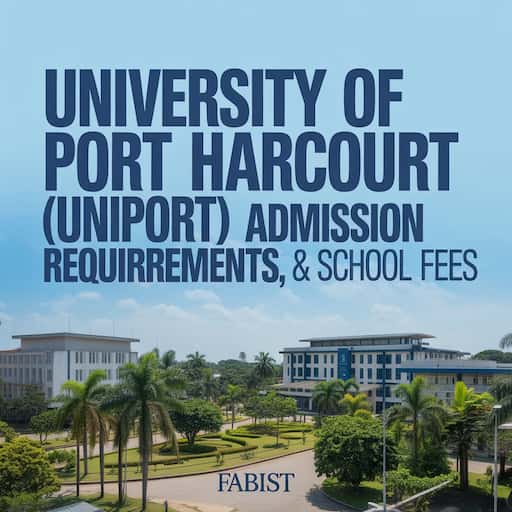
University of Port Harcourt (UNIPORT): Admission Requirements
Admission into University of Port Harcourt (UNIPORT) varies by the level of study:
For undergraduate admission through the Joint Admissions and Matriculation Board (JAMB), candidates must sit and meet a minimum UTME score. Although the exact general minimum can change from year to year, UNIPORT typically expects candidates to score above the national minimum cutoff and also perform in the UNIPORT Post-UTME screening. Candidates must have at least five credits in relevant subjects including English Language and Mathematics at O’level (WAEC, NECO, or equivalents) in not more than two sittings. The choice of subjects depends on the course applied for. Applicants must also participate in the institutional screening after UTME. The minimum age for undergraduate admission is usually 16 years.
Direct Entry applicants must have relevant qualifications such as A-Level certificates, National Diploma (ND), Higher National Diploma (HND), NCE, IJMB, or equivalent in related subjects, and must meet the specific programme requirements. This route allows candidates to enter into the second year of study in most cases.
For postgraduate admission, candidates generally need a minimum Bachelor’s degree with a specified grade point average (often at least second class lower division for Master’s programmes). For Ph.D admission, a relevant Master’s degree is usually required with a minimum CGPA standard and sometimes an interview or written proposal defense. Professional qualifications may also be recognized where applicable.
University of Port Harcourt (UNIPORT): School Fees Structure
School fees at University of Port Harcourt (UNIPORT) vary widely by faculty, level of study, and whether a student is a fresh or returning student. Fees can change from one session to another, so the figures below reflect typical ranges that have been reported for recent academic sessions.
Undergraduate school fees for new students often differ by faculty. For example, fees for agriculture and science related programmes have been reported around the mid-hundred thousand naira range per session, while highly specialised programmes like clinical sciences might be higher. Some typical figures from recent sessions include agricultural programmes around one hundred twenty-seven thousand naira or similar, education and humanities programmes around ninety-eight thousand naira, and other disciplines within similar ranges. Returning students usually pay reduced fees compared to fresh students.
There are additional compulsory charges outside tuition, such as acceptance fees, matriculation fees, library and technology levies, medical fees and other sessional charges. These additional fees are paid through the university’s official payment portal.
Part-time and continuing education programmes also have their own fee structures which may be set differently from full-time programmes and are often uniform across departments.
Hostel accommodation and related fees for students living on campus or specific to certain programmes (such as student hostels for medical or postgraduate students) are also charged separately and vary depending on the facility and programme.
University of Port Harcourt (UNIPORT): How to Apply
Undergraduate applicants firstly register for JAMB UTME and choose University of Port Harcourt (UNIPORT) as a preferred choice of institution. After writing the UTME and meeting the required score, candidates are expected to register for UNIPORT Post-UTME screening usually through the university portal. Direct Entry candidates apply through JAMB and UNIPORT screens them based on their qualifying certificates and other requirements.
For postgraduate admission, candidates apply directly through the university’s postgraduate portal or specific graduate school portals, upload required documents, pay any application fees, and meet the departmental and school requirements as stated in the programme adverts.
Conclusion
The University of Port Harcourt (UNIPORT) offers a broad and flexible range of academic programmes for undergraduate and postgraduate students across diverse faculties and disciplines. Admission requirements are clear and set to ensure candidates are academically prepared. School fees reflect the level and nature of the programme of study, and prospective students are encouraged to check the official university portal or admissions office for the most current and accurate information for the session they wish to apply.


 Courses, Admission Requirements, & School Fees)