
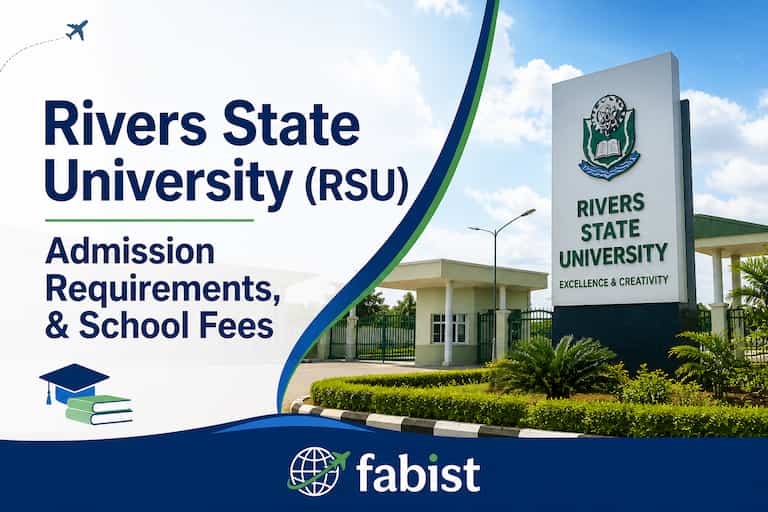
Rivers State University (RSU) is one of Nigeria’s prominent state-owned institutions located in Port Harcourt, Rivers State. It is a comprehensive university with a long history of academic service, evolving from a science and technology focus to a broad curriculum encompassing many disciplines. The institution is known for its strong engineering and environmental studies programs as well as its expanding offerings in medical sciences and other fields.
As a state university making education accessible to large numbers of Nigerian students, Rivers State University (RSU) attracts applicants from all over the country. Understanding the full landscape of what RSU offers requires exploring three main areas: the array of courses available, the general and specific requirements for gaining admission, and the school fees required to study there. Each section below provides extensive detail that prospective students, families, and educational planners can use to prepare adequately for application and enrollment.
Rivers State University (RSU): Courses
Rivers State University (RSU) has a wide diversity of courses organized into faculties and colleges that reflect the needs of a modern university. Over time, RSU has expanded beyond its original science and technology focus to include liberal arts, social sciences, business studies, law, environmental sciences, agriculture, basic and clinical medical sciences, and more.
-
College of Medical Sciences
One of the newer and most competitive academic units at RSU is the College of Medical Sciences. This college includes programs that prepare students for careers in medicine, nursing, and other health-related professions. Some of the courses offered here include:
- Medicine and Surgery
- Nursing Science
- Human Anatomy
- Human Physiology
- Medical Biochemistry
These programs are highly competitive, especially Medicine and Surgery and Nursing Science, because they are among the most sought-after degrees in Nigeria’s educational system. Training in these areas involves rigorous scientific coursework and clinical exposures to healthcare environments.
-
Faculty of Engineering
Engineering remains one of RSU’s strongest areas of academic reputation. The programs available within this faculty reflect the technological and industrial demands of the region, particularly those aligned with Nigeria’s oil and gas sector. Well recognized engineering programs at RSU include:
- Agricultural and Environmental Engineering
- Chemical and Petrochemical Engineering
- Civil Engineering
- Computer Engineering
- Electrical Engineering
- Marine Engineering
- Mechanical Engineering
- Petroleum Engineering
Of these, Marine Engineering and Petroleum Engineering have historically attracted applicants from both engineering and technical backgrounds due to RSU’s location near the Niger Delta and its relevance to maritime and energy industries.
-
Faculty of Science
The Faculty of Science offers programs that cover the core natural and applied sciences. These courses are designed for students who wish to pursue careers in research, scientific industries, laboratory science, education, or further postgraduate studies. Key science programs include:
- Animal and Environmental Biology
- Biochemistry
- Chemistry
- Computer Science
- Geology
- Mathematics
- Medical Laboratory Science
- Microbiology
- Physics
Computer Science and Medical Laboratory Science, in particular, are among courses with high application rates due to their contemporary relevance and demand in the job market.
-
Faculty of Environmental Sciences
RSU’s Faculty of Environmental Sciences trains students in disciplines that deal with the planning, development, and management of built and natural environments. These courses are especially relevant for students interested in careers like architecture, surveying, urban planning, and environmental management. Some of the main programs include:
- Architecture
- Estate Management
- Quantity Surveying
- Environmental Management
- Urban and Regional Planning
- Surveying and Geomatics
Students in these programs learn how to design, evaluate, and manage environments ranging from buildings to entire regions.
-
Faculty of Management Sciences
The Faculty of Management Sciences prepares students for a wide range of organizational and business roles, from finance to marketing and operations. Courses in this faculty often include:
- Accountancy
- Banking and Finance
- Management
- Marketing
- Mass Communication
- Office and Information Management
These programs help students build skills in leadership, financial analysis, business strategy, and communication that are essential in private and public sectors.
-
Faculty of Social Sciences
The social sciences focus on understanding human behavior and societal dynamics. RSU’s offerings in this area include:
- Economics
- Geography and Environmental Management
- Political Science
- Psychology
- Sociology
These courses help prepare students for careers in policy, research, community development, governance, and beyond.
-
Faculty of Humanities
The Faculty of Humanities provides education in fields that examine culture, history, language, and thought. Among the programs in this faculty are:
- English and Literary Studies
- French
- History and International Diplomacy
- Philosophy
- Religious and Cultural Studies
- Theatre and Film Studies
These degrees develop students’ abilities in critical thinking, communication, cultural analysis, and creative expression.
-
Faculty of Law
Law is offered as a professional program leading to the Bachelor of Laws degree. Students in this faculty study a range of legal disciplines including public law, private law, international law, and jurisprudence. A law degree from RSU prepares students for careers in legal practice, public service, and corporate advisory roles.
-
Faculty of Education
RSU also trains future educators through its Faculty of Education. These programs are designed to prepare graduates to teach at various levels of education and to take on roles as educational managers, counselors, or curriculum specialists. Courses here include science education, technical education, library science, and educational administration.
Overall, the variety of courses at RSU reflects a comprehensive university system that accommodates diverse academic interests and professional goals. Students can choose programs based not only on traditional academic strengths but also on emerging areas of study and employment.
Rivers State University (RSU): Admission Requirements
Gaining admission into Rivers State University requires several steps that align with national standards in Nigeria and RSU’s own internal policies. Prospective students must meet conditions set by the Joint Admissions and Matriculation Board (JAMB) as well as additional criteria established by RSU. These requirements differ by program, but generally cover both academic preparation and procedural compliance.
-
UTME and O’Level Requirements
Undergraduate candidates seeking admission through the Unified Tertiary Matriculation Examination (UTME) pathway must first register for JAMB, sit the UTME, and choose RSU as their first choice institution. Applicants are expected to achieve a minimum score set by JAMB, but RSU often applies its own internal cut-off marks that are higher, especially for competitive courses like engineering, law, and medical sciences.
In addition to UTME scores, students must have at least five credit passes in their Senior Secondary School Certificate Examination or equivalent. These credits must typically include English Language and Mathematics, along with other subjects relevant to the intended degree. For example, science-based programs often require credits in subjects like Physics, Chemistry, and Biology; while arts and social science programs may require credits in subjects more closely related to humanities.
-
Post-UTME Screening
After meeting the UTME and O’Level requirements, candidates must participate in an RSU Post-UTME screening. This is a university-level aptitude test designed to further assess applicants’ academic readiness and determine final admission offers. Results from this screening, combined with UTME performance, play a key role in which applicants are admitted.
-
Direct Entry Applicants
Direct Entry is a separate pathway that allows candidates with advanced qualifications above the UTME level—such as A-Levels, National Diploma (ND), Higher National Diploma (HND), or equivalent certification—to apply directly into 200 or 300 level. For direct entry, candidates must provide evidence of relevant qualifications and meet minimum grade and subject requirements that align with the chosen course of study.
-
Special Requirements for Competitive Programs
Certain courses at Rivers State University (RSU) are more competitive due to the nature of the profession or limited space. Law, medical sciences, and some engineering programs require higher UTME scores and stronger academic records than other courses, and some departments may hold interviews or additional tests to assess aptitude. Given this competitive environment, applicants should aim well above the minimum requirements where possible and prepare thoroughly for post-UTME assessments.
Rivers State University (RSU): School Fees
Understanding the school fees structure at RSU is essential for planning finances before and during university education. Tuition and related costs at RSU vary based on the faculty, whether a student is a Rivers State indigene or from another state, and whether they are fresh or returning students. Additionally, students may incur other mandatory charges beyond tuition.
-
Tuition Fees by Faculty
School fees at RSU are structured around the faculty and programme of study. Fresh students typically pay a defined tuition rate based on their department, while returning students usually pay slightly reduced amounts. For the 2025/2026 academic session, an illustrative breakdown of tuition fees for selected courses is as follows:
- Basic Medical Sciences and College of Medical Sciences: Fresh RSU indigenes may pay around eighty-five thousand naira per session, while students from other states might pay about one hundred and forty-five thousand naira. Returning students pay slightly less depending on year level.
- Engineering Programs: Courses such as agricultural, chemical/petrochemical, civil, computer, electrical, marine, mechanical, and petroleum engineering typically have tuition fees around seventy-five thousand naira for Rivers State indigenes and one hundred and twenty-five thousand naira for non-indigenes, with returning students paying lower rates.
- Environmental Sciences: Architecture, estate management, quantity surveying, surveying and geomatics, and urban and regional planning tend to have fees starting around sixty-five thousand naira for indigenes and about one hundred and fifteen thousand for non-indigenes.
- Humanities, Management Sciences, Social Sciences, and Education: These faculties generally have similar fee structures, often beginning near sixty-five thousand naira for RSU indigenes and about one hundred and fifteen thousand naira for students from other states.
- Science Programs: Departments such as biology, chemistry, computer science, geology, mathematics, and physics generally align with the humanities fee range, with fresh indigene fees near sixty-five thousand naira and other-state fees near one hundred and fifteen thousand naira.
These figures represent tuition fees per academic year and do not include additional mandatory payments such as acceptance fees or optional costs like accommodation.
-
Acceptance Fee
When a candidate is offered admission at RSU, they must pay an acceptance fee to secure the placement. For the 2025/2026 session, this fee has been reported at around thirty-nine thousand one hundred and fifty naira. This fee is non-refundable and is paid once per student at the time of admission acceptance.
-
Optional Fees and Charges
In addition to tuition and acceptance fees, students often incur costs related to campus life and services. These may include medical fees, ICT levies, library development contributions, departmental dues, faculty dues, hostel accommodation, and student union government charges. While these additional costs vary by academic session and specific university policies, they should be anticipated as part of the overall cost of attendance.
Hostel accommodation, for example, may cost roughly thirty-thousand to forty-thousand naira per session. This fee is usually optional for students who choose to live in campus hostels, and rates can vary based on location and facilities available.
Conclusion
Rivers State University (RSU) stands as a comprehensive institution providing a wide range of courses and academic opportunities for students across multiple disciplines. From the competitive College of Medical Sciences to engineering, humanities, social sciences, and technical programs, RSU offers numerous pathways for students to pursue their educational and professional goals.
The admission process requires careful preparation of academic credentials, satisfactory performance in national examinations like UTME, and participation in the university’s post-UTME screening. The cost of studying at RSU is structured to reflect the nature of the program and whether a student is a state indigene or from another region, and while tuition is the primary fee, other charges must be expected during the course of study.




 Courses, Admission Requirements, & School Fees)