Over the years, it has increasingly become a difficult task for young persons to choose from among top rated and best universities to enroll in. yet, it is also very important that you choose the very best to avoid making mistakes, as it is what paves the way for career opportunities, personal growth, and lifelong friendships, amongst others.
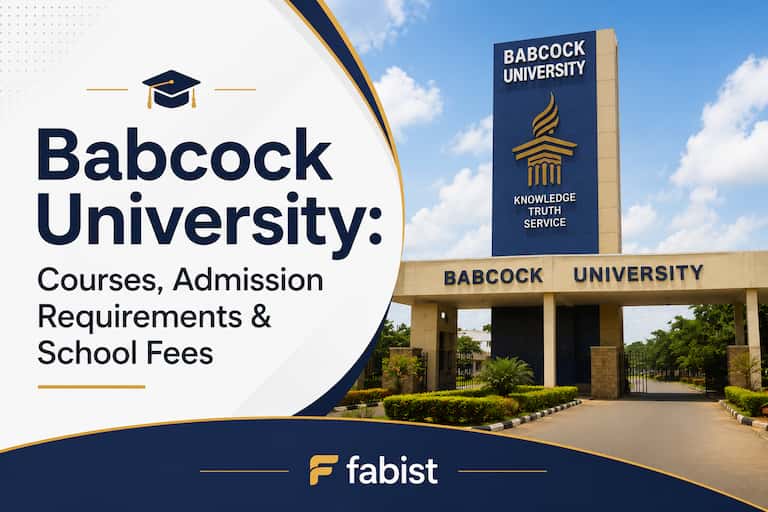
However, we are here to help you with your choices, especially in today’s competitive educational landscape in Nigeria. Out of the numerous institutions in Nigeria, Babcock University is one of the best that stands out. It is one of the most popular and respected private universities and further in this post, we will tell why, as well as the courses it offers, admission requirements and school fees.
Also Read: West Midlands Open University: Courses, Admission Requirements, and School Fees
Babcock University: What You Need to Know
You must have been hearing about the Babcock University and what they are all about or you must have been wondering how they became so popular and what makes them stand out. Well! We are proud to tell you that Babcock University is indeed a top quality education center that has lived up to its hype over the years.
Babcock University is located in Ilishan-Remo, Ogun State, in Nigeria and is a Christian institution that goes beyond instilling Christian lifestyles by building a reputation for top class academic excellence, holistic formation, and strategic industry importance. This institution was named after David C. Babcock, an American missionary, who is the pioneer of the Seventh-day Adventist Church in Nigeria in 1914.
Because of its high standard of learning and moral values, Babcock University has attracted students from all over the country and beyond, especially those looking for top class education with moral grinding. It was founded in 1959 by the Seventh-day Adventist Church and operated by the Christian institution.
Meanwhile, initially, Babcock University was founded and called the Adventist College of West Africa (ACWA) in 1959, and started with seven students that were hosted at Chief Olufemi Okulaja’s home. Subsequently, it was renamed Adventist Seminary of West Africa (ASWA) in 1975, and was formally inaugurated on 20 April 1999. The school is among the Seventh-day Adventist education system, the second largest in Nigeria.
Babcock University graduated its first sets of students in 2017, from the Ben Carson School of Medicine. It initially had four schools, and has now added a postgraduate school during the third quarter of 2010, as well as medical school in 2012. There were several other new additions including School of Social Sciences, School of Management, School of Science & Technology, School of Health & Medical Sciences, etc.
Babcock University: Courses
There are certain questions that keep on popping out in our page and on the internet asking if Babcock University offers many programs that one can pick from. Well! In this institution, you can find a lot of different courses, such that you will have many options to pick amongst them the program of your dream.
In Babcock University, you can chose among varieties of programs across multiple faculties ranging from Science & Technology, Business Administration, Humanities & Social Sciences, Health Sciences, Law, management Sciences and Education. In this article, we would be highlighting the various programs of the Babcock University and their different faculties;
-
Benjamin S. Carson Senior College of Health and Medical Sciences
Medical and allied health professions are among the most sought-after courses in Nigeria, and Babcock’s medical programmes are highly respected.
- MBBS Medicine and Surgery — A 6-year intensive programme training future doctors with a clinical focus.
- B.N.Sc Nursing — A five-year degree for future nurses.
- BMLS Medical Laboratory Science — Prepares students for work in diagnostic and clinical lab environments.
- B.Sc Public Health — Focuses on community health, prevention science, and public policy.
- Human Anatomy, Physiology, Biochemistry — Core foundational biological disciplines.
-
School of Computing and Engineering Sciences
Technology is one of the fastest growing sectors globally, and Babcock equips students with critical IT and engineering skills.
- B.Sc Software Engineering — Focuses on software design, development, and deployment.
- B.Sc Computer Science — Covers fundamental computing, algorithms, and systems.
- B.Sc Information Technology — Emphasizes practical applications of tech in business and society.
-
School of Management Sciences
If you have been dreaming of being in leadership, finance, or business strategy, this is your hub.
- B.Sc Business Administration — Core business management skills with ethical leadership focus.
- B.Sc Accounting — Prepares students for careers in finance, audit, and corporate accounting.
- B.Sc Finance — Focuses on investment, financial analysis, and capital markets.
- B.Sc Economics — Combines analytical economic theory with real-world policy.
- B.Sc Marketing — Emphasizes consumer behavior, branding, and market strategy.
- B.I.R.M. Information Resources Management — Bridges tech and business data management.
These programmes forge leaders who can innovate and compete in the local and global marketplace.
-
School of Science & Technology
If you are interested in science, this school provides broad scientific training with practical labs and research components.
- B.Sc Biology — Wide ranging biological science foundation.
- B.Sc Microbiology — Preparation for careers in research, healthcare, and biotech.
- B.Sc Biochemistry & Physiology — Integrative biological sciences.
- B.Sc Chemistry — Core chemical science fundamentals.
- B.Sc Animal Science — Focus on animal biology and production systems.
- B.Sc Agricultural Economics & Extension — Blends agriculture with economic planning.
-
School of Education and Humanities
You just have been having dreams of being an educator and culture-shaper; you can go for strong programmes like the following;
- B.A English Studies — For careers in education, writing, and communication.
- B.A History & International Studies — Focus on global history, diplomacy, and policy.
- B.A French & International Relations — A unique blend of language and global affairs.
- B.A Christian Religious Studies — Explores faith, ethics, and cultural interaction.
- B.A Music, Education Programmes (Business & English) — Equips educators and creative artists.
-
School of Public and Allied Health
This school focuses on community health, health sciences, and preventive care.
- Public Health — Prepares graduates for health program leadership.
- School of Law & Security Studies
Law remains one of the most sought after disciplines in Nigeria.
- LL.B Law — A five-year degree that prepares students for legal practice and advocacy.
Babcock University: Admission Requirements
Just like other institutions, there are certain criteria that you must meet if you want to become a student of Babcock University. For instance, you must have five (5) credits in relevant courses including English & Math in WAEC/NECO/NECO, and it must not be more than two sittings, you must also score above 170 in your JAMB score, amongst others. Below are the highlights of the basic requirements;
-
Basic Academic Entry Requirements
For most undergraduate programmes, applicants must have at least five credits in relevant subjects from the SSCE/WAEC/NECO or equivalent examinations, and these credits should usually be obtained in not more than two sittings. English Language and Mathematics are generally mandatory for most courses.
-
UTME and Cut-off Score
- You must sit the Joint Admissions and Matriculation Board (JAMB) Unified Tertiary Matriculation Examination (UTME).
- The minimum aggregate score is usually around 170 or higher, depending on the programme you apply for.
- You must select Babcock University as your first choice institution in your JAMB application.
-
Direct Entry
If you have advanced qualifications (such as A-levels, National Diploma with upper credit, or other recognized equivalents), you may be eligible for Direct Entry into 200 level for many programmes.
- Programme-Specific Requirements
Some competitive programmes such as Medicine, Law, Engineering, and Nursing have additional requirements, including specific subjects at credit level (for example Biology and Chemistry for medical programmes). Students should always check the detailed subject combination for their chosen programme — especially for competitive fields.
Babcock University: Admission Process & Steps
If you are candidate of Babcock University, and wish to get admitted to be part of the esteemed students with lots of benefits; then you must follow the steps below for your application process;
- Choose your preferred course and ensure you understand its requirements.
- Sit for JAMB UTME and select Babcock as first choice.
- Meet the cut-off score (usually 170 or above).
- Apply for Post-UTME/Screening through the official Babcock admissions portal once JAMB results are out.
- Submit supporting documents during the screening — like O’Level results and application documents.
- Await offer letter (conditional or unconditional).
- Accept the offer and pay acceptance fees before registration.
- Babcock also offers Direct Entry, JUPEB, part-time, and postgraduate pathways for non-UTME or advanced applicants.
Babcock University: School Fees
Just like some other private university, the Babcock University has certain fees that come with it. Hence, if you must successfully navigate your way through the periods of academic sessions, you just budget wisely. Below is a rundown of what to expect in terms of fees and other payment structures;
Babcock University undergraduate tuition and fees vary by department, with 100-level instructional fees for courses such as Accounting is around 1.17 million naira. Medical programs are higher, often exceeding 4.5 million naira per year. Total fees include tuition, accommodation, and a 150,000 naira non-refundable acceptance fee. Below is the breakdown;
-
Annual School Fees by Programme
- Arts, Education & Humanities programmes: Approximately ₦620,000 to ₦800,000 per academic year.
- Social Sciences & Management (e.g., Business, Economics): Around ₦700,000 to over ₦1,000,000 per session.
- Sciences & Computing: Around ₦700,000 to ₦1,500,000.
- Law: Generally higher, around ₦1,200,000 to ₦2,500,000.
- Medicine & Surgery (MBBS): Among the highest, estimated between ₦4,500,000 to ₦5,500,000 per annum.
- Nursing & Pharmacy: Around ₦2,500,000 to ₦4,000,000.
Kindly note that these are approximate 2025/2026 figures, and actual fees for 2026 may vary slightly as institutions adjust to economic conditions.
-
Other Compulsory Fees
Apart from tuition, Babcock University requires students to pay several extra compulsory fees:
- Acceptance Fee — A one-time charge upon admission (amount varies by programme).
- Laboratory Fees for science and health courses.
- Fraud Audit or IT Competence Fees where applicable.
- Hostel Accommodation — ₦99,120 to over ₦212,400 annually depending on the type chosen.
- Feeding Plans — (if students opt for campus meal plans) ranging from affordable to premium depending on preference.
Conclusion
Babcock University offers you a very unique academic aura that makes it stand out from the rest, and that is why it is one of the best and most popular private schools, not just in Nigeria, but also Africa. You will have no regrets recommending it for your loved one, as they produce the very best graduates that would go on to become prominent in their different fields.